Everest Expedition 2026 | Complete Mount Ever...
8 August, 2026
Read More
High on Mount Everest, far above the clouds and beyond the point where the human body can survive for long, there is a story that has haunted the mountaineering world for nearly three decades.
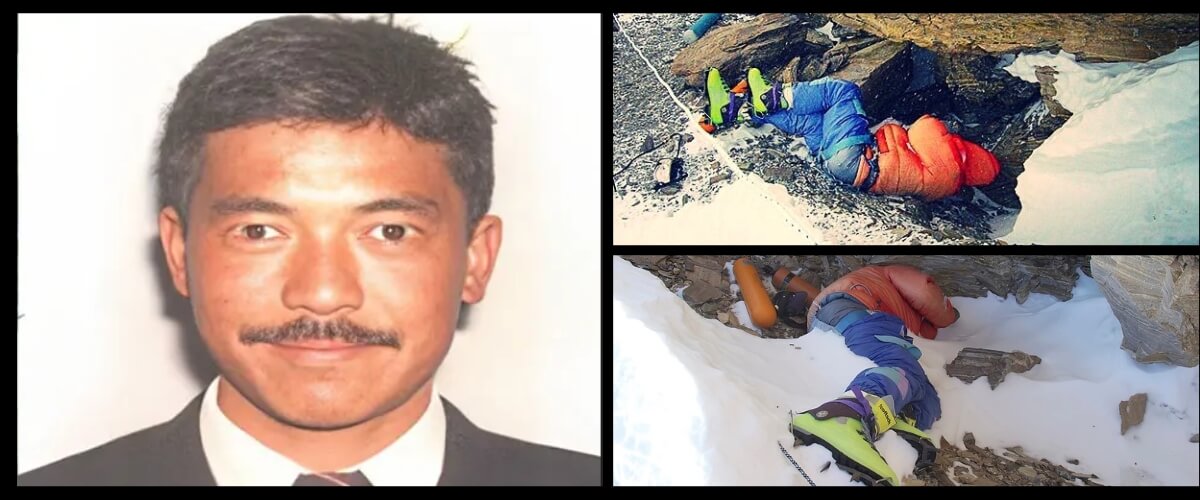
It is the story of Green Boots.
For years, climbers approaching the summit of Mount Everest from the northern side passed a small limestone alcove at approximately 8,500 meters (27,900 feet). Inside lay the frozen body of a climber, curled on his side, still wearing a pair of distinctive green mountaineering boots.
Those boots gave him the name by which the world came to know him.
No! For almost 25 years now, Green Boots has remained in Everest. Somebody actually buried the body with snow and stones upon Paljor’s family’s request. Nobody saw Green Boots between 2014 and 2017. However, in 2017, it resurfaced again, with more rocks surrounding the body.
For nearly 30 years, Green Boots was widely believed to be Tsewang Paljor, an Indian mountaineer and member of the Indo-Tibetan Border Police (ITBP) expedition that attempted Mount Everest from the north side in 1996.
Paljor was one of three Indian climbers who disappeared during the disastrous storm of May 10, 1996, one of the deadliest and most famous days in Everest history. The other two were Tsewang Smanla and Dorje Morup. For decades, the identification of Green Boots as Paljor was repeated in books, documentaries, news reports, climbing accounts, and conversations at Everest Base Camp.
However, an important development emerged in 2026.
Recent Indian government documents connected with plans to recover the body reportedly identify Green Boots as Dorje Morup rather than Tsewang Paljor. This has reopened one of Everest's longest-running mysteries.
This distinction matters.
Green Boots should not be remembered simply as an anonymous body or a strange landmark on Everest. Whether the climber is ultimately confirmed as Dorje Morup or whether further evidence changes the story again, he was a mountaineer who belonged to an expedition, had colleagues and family, and died while attempting one of the most difficult challenges on Earth.

To understand Green Boots, we have to return to May 1996.
That climbing season would become one of the most famous in Everest history.
On May 10 and 11, a powerful storm struck the upper mountain while several teams were attempting the summit. Climbers on both the northern and southern sides of Everest were caught in deteriorating conditions.
Much of the world's attention later focused on the disaster involving the Adventure Consultants and Mountain Madness teams on the Nepal side, a tragedy made internationally famous through books such as Into Thin Air.
But another tragedy was developing on Everest's northern side.
A six-member summit team from India's Indo-Tibetan Border Police was climbing toward the summit along the Northeast Ridge.
As conditions deteriorated, three members turned around.
Three others continued upward:
The decision would become fatal.
The three climbers later reported reaching the summit, although questions have long existed about exactly where they were when they made their final radio communication.
More importantly, they were extremely high on Everest very late in the day.
Then the storm closed in.
None of the three men returned alive.
Every Everest climber understands one fundamental principle.
Reaching the summit is only half of the journey.
The majority of mountaineering accidents happen during descent, when climbers are exhausted, oxygen reserves are lower, daylight disappears, temperatures fall, and concentration begins to deteriorate.
At more than 8,000 meters, these dangers become much greater.
Smanla, Morup, and Paljor were caught in exactly this environment.
They were tired, exposed to violent weather, and operating in an atmosphere containing roughly one-third of the oxygen available at sea level.
The temperature could fall far below freezing.
Visibility could disappear almost instantly.
Simple actions such as attaching a carabiner, opening a bottle, thinking clearly about direction, or communicating with teammates could become extraordinarily difficult.
Somewhere during that desperate descent, one of the climbers reached a shallow limestone overhang beside the route.
He never left it.
Over time, climbers began referring to him simply as Green Boots.
There was no mystery behind the nickname itself.
The climber was wearing bright green Koflach mountaineering boots, which remained clearly visible even as much of his body was surrounded by snow and ice.
The color made the body immediately recognizable.
Because of the position of the alcove beside the Northeast Ridge route, climbers began using the location as an informal geographical reference.
Eventually, the shelter itself became known as Green Boots Cave.
For climbers moving through the extreme upper reaches of Everest, passing Green Boots meant they were approaching one of the final sections of the climb toward the summit.
It was an extraordinarily uncomfortable form of landmark.
A person who had once climbed toward the summit with his own ambitions had become a reference point for the climbers who came after him.
Green Boots became associated with a small limestone alcove at approximately 8,500 meters on Everest's Northeast Ridge, on the Tibet side of the mountain.
This location lies deep inside what mountaineers call the Death Zone.
The Death Zone generally refers to elevations above 8,000 meters (26,247 feet).
At these altitudes, the human body cannot properly acclimatize.
Even while resting, a climber is gradually deteriorating.
Oxygen deprivation affects decision-making. Muscles become weaker. Dehydration becomes more serious. The risk of frostbite increases. Pulmonary and cerebral edema can develop.
A climber cannot simply remain there until conditions improve.
Time becomes one of the most important survival factors.
This is one reason recovering people, whether alive or dead, becomes extraordinarily complicated above 8,000 meters.
The term "Death Zone" sometimes sounds dramatic when used in stories about Mount Everest, but physiologically it describes a very real problem.

At approximately 8,000 meters and above, atmospheric pressure becomes so low that the amount of oxygen available to the body is insufficient for prolonged survival.
The body begins consuming itself simply to remain functional.
Climbers may experience:
Even highly experienced climbers using supplemental oxygen remain vulnerable.
A person who sits down because of exhaustion may find standing again almost impossible.
A climber who removes a glove for only a short time may suffer serious frostbite.
Someone who becomes disoriented can walk away from the established route without realizing it.
Green Boots became one of Everest's most visible reminders of this reality.
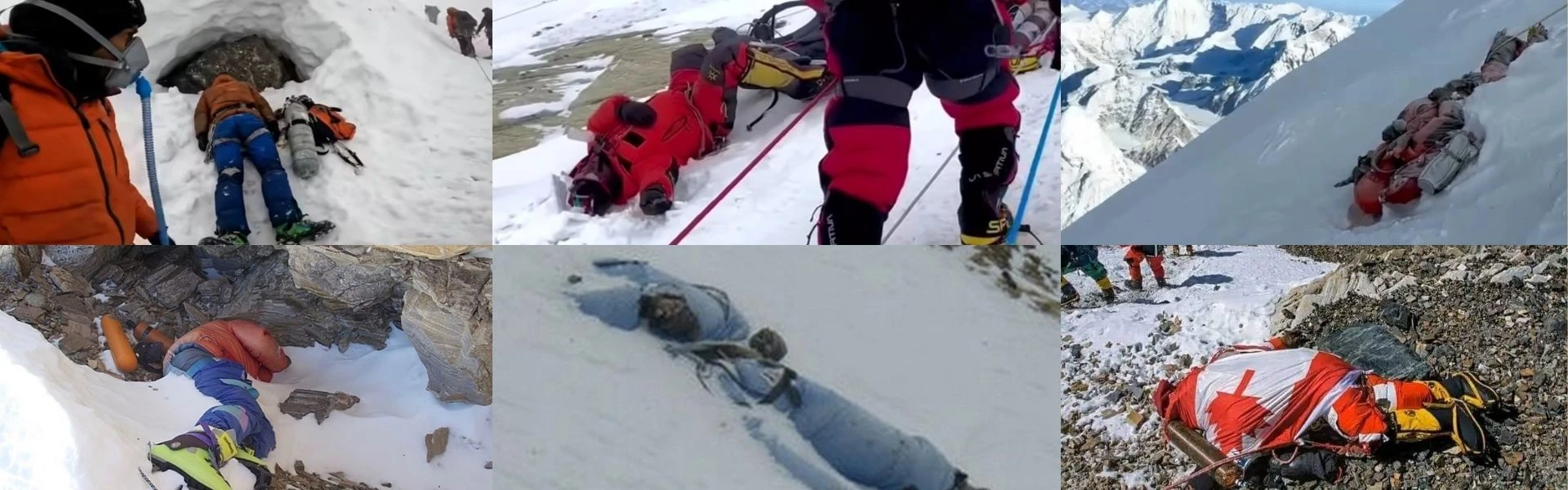
More than 200 bodies remain on Mount Everest, mostly trapped in the high-altitude "Death Zone" above 8,000 meters (26,000 feet). Extreme cold preserves these remains, and recovery is dangerously difficult or impossible, causing many to serve as grim landmarks along the climbing routes.
Data Source: List of people who died climbing Mount Everest - Wikipedia
One of the first questions people ask when learning about Green Boots is:
Why didn't somebody bring him down?
From sea level, recovering a body might seem like the natural thing to do.
At 8,500 meters, the situation is completely different.
Moving a frozen body from the Death Zone can require a team of extremely experienced high-altitude climbers, large quantities of supplemental oxygen, ropes, specialized equipment, favorable weather and enormous physical effort.
Bodies can freeze into the mountain.
Their effective weight and difficulty of handling can become enormous.
The recovery team must climb into the same environment that killed the person they are attempting to retrieve.
A recovery mission can therefore place several additional lives at risk.
Recent accounts of high-altitude body-recovery operations emphasize how difficult and dangerous it is to free frozen remains and transport them through technical terrain.
This is why many people who die high on Everest remain on the mountain.
Some disappear into crevasses.
Some become covered by snow.
Others are moved away from the climbing route when conditions permit.
For many years, yes.
On the north-side route, climbers frequently referred to Green Boots while describing their progress toward the summit.
This has created one of the more uncomfortable parts of the Green Boots story.
In countless internet articles, the climber is described as if he were simply an object marking a particular altitude.
But Green Boots was never merely a landmark.
He was a person.
The nickname may have been practical among mountaineers attempting to identify a location in one of Earth's most dangerous environments, but repeating the story without remembering the person behind it can easily become insensitive.
The better way to understand Green Boots is to see the location as a memorial to the risks of high-altitude mountaineering and to the climbers lost during the 1996 Everest disaster.
For decades, most accounts said yes.
Tsewang Paljor was a member of the ITBP expedition, died during the May 1996 storm, and was associated with distinctive green climbing boots.
As a result, the identification became accepted almost as fact.
But the evidence was never completely conclusive.
The climbers who died that day were operating in severe weather at extreme altitude. Precise information about their final movements was limited, and identification based largely on clothing was never equivalent to formal identification.
The story became even more complicated in June 2026.
Newly reported Indian government recovery documents identify Green Boots as Lance Naik Dorje Morup, one of Paljor's teammates who died during the same expedition. The documents form part of an attempt to recover the remains and return them to India.
Therefore, articles that simply state "Green Boots is Tsewang Paljor" without qualification are now outdated.
At present, the most accurate way to describe the situation is that Green Boots was long believed to be Tsewang Paljor, while recent Indian government documentation identifies the climber as Dorje Morup.
The planned recovery effort may eventually provide even greater certainty.
The precise final hours of the three Indian climbers remain difficult to reconstruct.
Extreme weather, poor visibility, conflicting accounts and the absence of survivors from the three-man group all contribute to the uncertainty.
What is clear is that Smanla, Morup and Paljor continued upward while several teammates had already turned back.
They later disappeared during the storm.
Japanese climbers who ascended the north route the following day reported encounters or sightings involving distressed climbers in the upper mountain, although accounts surrounding exactly what happened became disputed afterward.
The confusion illustrates something important about extreme-altitude rescue.
People sometimes imagine a climber encountering another person in trouble and simply choosing whether or not to rescue them.
At 8,500 meters, rescue can be much more complicated.
A severely exhausted climber may barely be capable of keeping himself alive.
Helping an incapacitated person descend technical terrain can require several rescuers.
There are situations where attempting a rescue without adequate personnel, equipment and oxygen can result in several deaths instead of one.
These are some of the hardest ethical questions in mountaineering.
The Green Boots cave became the center of another Everest tragedy ten years later.
In 2006, British climber David Sharp attempted Everest from the north side.
During his descent, he stopped in or near the same limestone shelter associated with Green Boots.
Sharp was still alive when other climbers passed the location.
His condition deteriorated and he ultimately died there.
The incident caused international controversy because numerous climbers were reported to have passed Sharp during their summit attempts.
Accounts differ about how clearly climbers understood his condition and what assistance was realistically possible, but his death triggered an enormous debate over mountaineering ethics.
Outside documented how Sharp was found near Green Boots and how the tragedy raised difficult questions about individual survival and responsibility at extreme altitude.
The incident forced the climbing community to confront an uncomfortable question:
How much responsibility does one climber have for another when helping could potentially cost both of them their lives?
There is no simple answer.
But the story changed how many people thought about commercial Everest climbing, summit priorities and emergency decision-making.
This question is more complicated than it first appears.
For years, Green Boots remained clearly visible beside the Northeast Ridge climbing route.
Reports later indicated that the body was moved away from its prominent position in 2014, making it much less visible to climbers. Outside reported that Chinese authorities had moved the remains away from the main trail.
Stories subsequently emerged suggesting that the body had occasionally been visible again, leading to confusion over exactly where the remains were located.
Then came the 2026 development.
Indian authorities reportedly began planning an operation to recover the body believed to be Dorje Morup and return the remains home, a technically demanding mission at approximately 8,500 meters.
Until such a recovery is definitively completed and officially confirmed, reports about the body's precise location should be treated cautiously.
An altitude of 8,500 meters is not simply a remote location.
It is one of the most hostile environments accessible to humans.
A recovery team would need to climb almost the entire mountain before the real operation even begins.
Members would need enough strength to work while already severely oxygen deprived.
The body may be frozen into ice or rock.
Ropes would need to be installed or used through dangerous sections.
The remains would then need to be lowered through extremely technical terrain.
Every additional hour spent at this altitude increases risk.
A sudden change in weather could transform a controlled recovery operation into an emergency.
That is why recovering a body from the Everest Death Zone can require enormous resources and exceptionally experienced mountaineers.
It also raises an important principle.
No recovery should demand another life.
Mount Everest is often described through numbers.
The tragedy offers several lessons that remain relevant to anyone considering an Everest Expedition.
Standing on top of Everest may be a lifetime dream, but no summit is worth ignoring deteriorating weather, physical weakness or turnaround times.
Experienced expedition leaders repeatedly emphasize that successful mountaineering means returning safely, not merely reaching the highest point.
Continuing upward too late can dramatically increase the risk of descending in darkness and worsening weather.
Summit fever can make turning around emotionally difficult.
Good judgment means being willing to abandon years of preparation when conditions no longer justify continuing.
Modern forecasting has significantly improved expedition planning, but Everest remains unpredictable.
High winds, snowfall and rapidly changing conditions can transform the upper mountain within hours.
Oxygen helps climbers function at extreme altitude, but it does not remove the risks associated with the Death Zone.
Regulator problems, empty cylinders, mask failures or delays can quickly become serious emergencies.
Experienced guides, reliable oxygen systems, strong Sherpa and high-altitude support, communication systems, weather forecasting, emergency planning and conservative decision-making are not luxuries on Everest.
They are fundamental components of expedition safety.
No. This is a common misunderstanding.
Travelers trekking to Everest Base Camp in Nepal do not see Green Boots.
The body became associated with the Northeast Ridge climbing route from Tibet, at approximately 8,500 meters.
Everest Base Camp on the Nepal side lies at approximately 5,364 meters, thousands of vertical meters below the summit.
Trekkers visiting Everest Base Camp are not entering the technical climbing sections of Mount Everest and will never approach the Green Boots location.
The story belongs to the extreme upper mountain, not the trekking route to Everest Base Camp.
Stories involving bodies on Mount Everest frequently become sensationalized.
Headlines describe "frozen bodies," "dead climber landmarks," or the "graveyard of Everest."
Such descriptions generate attention, but they can easily obscure the people involved.
Every climber who died on Everest had a name.
They had families.
They trained for years.
They carried ambitions, fears and reasons for climbing.
The mountaineering community owes them more than curiosity.
Green Boots should therefore not be remembered simply because a pair of green boots remained visible in the snow.
He should be remembered as one of the climbers lost during a remarkable and tragic chapter of Himalayan mountaineering history.
Almost thirty years after the 1996 disaster, the Green Boots story continues to evolve.
For decades, the world believed the climber was Tsewang Paljor.
In 2026, newly reported Indian government documents connected with a planned recovery operation identified him instead as Dorje Morup.
That development reminds us how easily a nickname can become more famous than the person behind it.
Somewhere beneath all the stories about Green Boots is something much simpler.
A mountaineer left home.
He climbed toward the highest point on Earth.
A storm arrived.
He never returned.
For thousands of climbers who followed the Northeast Ridge in later years, the green boots became a warning written into the landscape itself.
Everest can offer one of the greatest moments of a mountaineer's life.
But the summit is never guaranteed.
And reaching the top has never been the most important part of climbing Everest.
Coming home is.
Green Boots is the nickname given to a climber who died during the 1996 Everest disaster and whose body remained for years in a limestone alcove at approximately 8,500 meters on the Northeast Ridge. He was long believed to be Indian climber Tsewang Paljor. However, Indian government documents reported in 2026 identify the climber as Dorje Morup.
The nickname came from the distinctive bright green Koflach mountaineering boots visible on the climber's body.
The body was historically located in a limestone alcove at approximately 8,500 meters on the Northeast Ridge route from Tibet. Reports indicate the remains were moved away from the main route in 2014, and a recovery operation has been proposed in 2026.
Members of the 1996 Indian ITBP expedition communicated that they had reached the summit, but uncertainties remain concerning the precise movements and positions of the three climbers during their final hours.
Not in the way he once was. The body was reportedly moved away from its highly visible position beside the climbing route in 2014. Recent plans have also been reported for recovery of the remains.
Helicopter performance becomes severely restricted at extreme altitude, while the terrain and weather near Everest's summit make conventional helicopter recovery extraordinarily difficult. High-altitude recoveries therefore frequently require climbers to physically lower or transport remains through dangerous terrain.
No. Green Boots is associated with the Northeast Ridge at roughly 8,500 meters on the Tibet side. Everest Base Camp trekking in Nepal does not pass anywhere near the location.
Above approximately 8,000 meters, humans cannot acclimatize sufficiently for long-term survival. Oxygen deprivation, severe cold, exhaustion, dehydration, cerebral edema, pulmonary edema and impaired judgment make prolonged exposure extremely dangerous.
![Complete Guide to Mera Peak Climbing 2026 [Updated]](https://makaluadventure.com/public/uploads/frontend/thumb/mera_peak_climbing_168883208074961.jpg)