Trusted by travelers from around the world
Read real stories from travelers who explored mountains, rivers, trails, cultural routes, and once-in-a-lifetime journeys with Makalu Adventure.
Activity Level
Challenging
Duration
56 Days
Suitable For
16 to 79 years old
Best Season
Mar-May / Sep-Dec
Region / Country
Nepal
Group Size
On Request
Lhotse South is one of the most challenging and difficult Expedition route over 8000m and is regarded as the most dangerous ascends over many decades. Lhotse Expedition from South Face has very few successful ascends. This expedition is a 56-day expedition along the most challenging routes to the World’s fourth highest peak after Mt Everest, Mt. K2 and Mt. Kangchenjunga. Mt. Lhotse Expedition from South Face is known for its challenging route to ascend Mt. Lhotse standing at an altitude of 8,516m. Experience the fascinating sceneries and thrilling adventure as you climb the Lhotse South with our team. Lhotse is a massif of the Everest. Lhotse has 3 peaks. Lhotse (8,516m) Lhotse Shar (8,383m) and Lhotse Middle (8,414m).
The name Lhotse came from Tibetan language as Lhotse means ‘South’. The Lhotse Peak (8,516m) lies in the border of the Khumbu region of Nepal and China. It is a part of the massif of The Everest. Lhotse has a dramatic and wide face. What makes the Lhotse South dramatic and dangerous is its 3.2km rise within 2.25km horizontal distance. This makes Lhotse South the steepest face of this size in the globe.
There are numerous climbers who have successfully climbed Lhotse through the normal route. However, the South Route is almost impossible as climbers need to climb up the 3,300m (11,000ft) huge wall with fighting against snow, rocky steep, avalanche and winds. Many extraordinary Mountaineers like Reinhold Messner and Jerzy Kukuczka attempted to succeed in climbing Lhotse from South Face, but they experienced breakdown and even lost their lives.
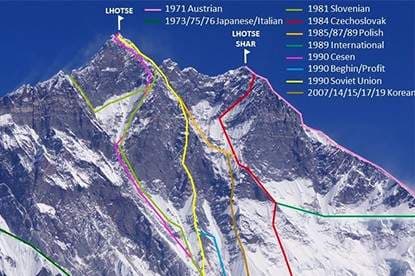
After many attempts first ascent on Lhotse Shar via its south face was first successfully climbed in 1984 by a Czech-Slovakian team.
The Lhotse South wall has strong winds, cold temperature along with icy and rocky climb which makes it one of the most rarely attempted climb. The Lhotse South Expedition has a standard route to Lhotse, a steep Lhotse Wall with unpredictable weather, which is challenging and most dangerous part of the climb.
Makalu Adventure provides you a safe and exciting journey with appropriate and best logistics and well-planned itineraries. We offer our utmost services for your comfort during the journey at a reasonable price. The team provided to you will be a group of skilled professionals so that the journey is smooth and safe. A team of Sherpas and porters will set up the ladders, ropes and determine the safest route for you to travel. The guide will be responsible to accompany on your journey for the best and safest experience and has the authority to change the itinerary if there occurs anything that might intervene in your safety.
Cost: USD 39,500 per person for Full Expedition services with highly experienced climbing Sherpas.
| Arrival Date | Departure Date | Options | Price |
| Sat, June 6 2026 | Fri, Jul 31 2026 | Booking Open | $ 39,500 |
| Tue, Jun 8 2027 | Mon, Aug 2 2027 | Booking Open | $ 39,500 |
| Arrival Date | Departure Date |
| Sat, June 6 2026 | Fri, Jul 31 2026 |
| Tue, Jun 8 2027 | Mon, Aug 2 2027 |
| Arrival Date | Options | Price |
| Sat, June 6 2026 | Booking Open | $ 39,500 |
| Tue, Jun 8 2027 | Booking Open | $ 39,500 |
The Lhotse Base Camp is located on the top of a moving glacier which is 5,200 m or 17,060 ft above sea level. The surrounding there changes constantly so we shift our tents as the ice melts. We will stay there mostly to have pre climb training sessions and rest. It is also known as the Lhotse south Base Camp. The place is beautiful with snow and ice boulders and you get to see a spectacular view of Mt. Lhotse (8,516 m), Mt. Nuptse (7,816 m), Mt. Ama Dablam (6,812 m), Island Peak (6,189 m), and many other mountains.
Camp I is situated on at the altitude of 5,900 m. The camp I is a desolate place and used to rest and shift to Camp II
Camp II is located at 6,400 m above sea level in a lateral moraine at the bottom of south ridge. It is more sheltered than camp I. It is main acclimatization camp.
Camp III is located on a south east ridge on the Lhotse wall. Many climbers find difficulty climbing to Camp III because of the high altitude. Many climbers feel the effects of high altitude like dizziness, headaches. So we rest there and let our body adjust to the climate and surrounding.
Camp IV is a flat area with loose rocks and with Lhotse on the south. The Climb is very steep and the rise ranges from 40-45 degrees. It is the last camp before we climb the summit. The Lhotse Camp IV is located at an altitude of 7,900m/ 25,918 ft.
The day of the Ascend is decided by the team leader. Usually, team leader sees the temperature, humidity, wind and rain from Camp IV. And if everything is stable, team heads for summit overnight (usually 11:00 to 2:00 AM) depending on above situations, reach summit by morning 9-10 AM and then return back to Camp II. The victory to the Lhotse from South face completes here and you share your victory of ascend over Lhotse after reaching Camp II. Weather can change anytime in the Himalayas, so just relax, keep calm and return back to Camp II after summit.
If you wish to discuss any aspect of the expedition or your suitability for it, please contact us by telephone: + 977 1 4417522 (office hours 10:00 to 18:00 NST) – Mobile/WhatsApp 00977- 98510 -37083 (24/7)
Alternatively, you can contact us by email – info@makalu-adventure.com
Note: Mentioned costs are based on the current royalty structure as per the Government of Nepal. In case of increase in royalty by the year 2026, the same will be applied in the mentioned costs.
If you would like to book a place on this expedition, please contact us. The US$2,000 (per person) deposit for this expedition will secure you a place on this expedition. The final balance can be settled 15 days prior to the groups arrival in Nepal.
Best time for ascend
The climate in Lhotse is mostly cold and windy. The temperature ranges 20 degrees Celsius to -25 degrees. The nights are even colder and may reach up to -30 degrees Celsius. The mornings are usually calm however it can get very windy during the afternoon. Hence, most climbs are finished before noon.
The best time to climb Lhotse is during the late spring season. It is warmer, stable and a lot safer to travel. Also known as pre monsoon season (April to May), the temperature will range from 10 degree Celsius to -15 degrees during the day. While during the night, the temperature may drop down to up to -25 degrees. The post monsoon seasons are also a great time to travel It is a bit colder than Pre monsoon seasons.
History of Lhotse South Face Expedition
Know before you travel
PREVIOUS EXPERIENCE/FITNESS
You should be technically competent with previous high altitude experience. Summit success will require a high level of aerobic and mountain fitness. Lhotse south expedition is a technical climb, extremely demanding both physically and mentally.
IMPORTANT – The small print
Please note, if for any reason you need to return to Kathmandu separate from the whole group, there will be costs incurred which you will need to pay. These might include transfer costs, cost to change flight. In this situation you should claim back any cost through your insurance policy.
CHANGE OF INTERNATIONAL FLIGHTS
We allow several extra days in the itinerary for bad weather. If you do summit or come back early we can rebook your international flight but additional costs may/will be incurred. Tickets can be changed according to availability and the class of ticket, you may need to upgrade and be flexible on your return date. All additional payments would need to paid for in Kathmandu (card payments accepted).
RESPONSIBLE TOURISM
We employ local staff to work alongside our own group leader giving them employment. We will have our shower setup at ABC, and if you would like a bowl of hot water to wash in, then just ask the cook. Wet wipes also work really well as an alternative. We recommend you take items such as batteries back to Kathmandu for recycling.
ALTITUDE
You should already be familiar with the effects of altitude from your previous experience. However if you are new to mountaineering at extreme altitude you may still have concerns about the effects of altitude. Don’t worry, our itinerary allows sufficient time to acclimatise. The best way to avoid such symptoms is to do everything slowly,walk at a steady pace and drink plenty of fluid. Should you be the exception, we can allow you to stay an extra night at a lower level and follow with one of our local guides.
USEFUL TIPS
Just in case your main luggage goes missing en route, it isa good idea to wear your boots on the plane. Most other things can be replaced but comfortable, well worn-in bootsare more difficult to replace easily.
EQUIPMENT
A detailed equipment list is provided on booking.Specialist items such as sleeping bags and down jackets can be hired or purchased in Kathmandu at very good rates.
BAGGAGE
For your own comfort, travel light. For such a long trip it’s amazing how quickly the weight adds up. Some items can be left at the hotel for your return. A suitable kit bag is provided but important items should also be packed in plastic bags. A27-35litre day sac is needed to carry a fleece, rain gear,gloves, water bottle, camera and guidebook, for the acclimatisation walks.
VISAS AND PERMITS
You can obtain Nepal Visas on arrival at Kathmandu airport. Passports must be valid for at least six months after the end date of the trip.
LOCAL COSTS
Individuals are responsible for drinks throughout and hotel meals which gives the flexibility to choose where you eat.The following approximate costs (mid range) may vary:
CURRENCY
Nepalese Rupee. UK Sterling, Euros and US Dollars can easily be changed in Kathmandu. ATM (cash machines)are available in Kathmandu. Approx 145 rupees to £1 or 120 rupees to US$1
TIPPING
Tipping is generally expected and part of everyday life.We recommend around $300 per person for this trip. It is also usual to put approximately USD 25 into the pot for the Puja or mountain blessing.
INSURANCE
Insurance which covers mountain rescue, helicopter evacuation and medical expenses is essential.
A TYPICAL CLIMBING DAY
Starts around seven am getting breakfast and a brew ready.Most climbing days are between 6 – 8 hours and will feel quite strenuous; this will get easier as time goes by with acclimatisation. The team should be able to move between camps without assistance. However, the leader will aim to have regular radio calls to keep in contact with all the group.
WHAT TO CARRY
On the trek you should aim to carry a light rucksack containing 1-2L of water, waterproofs, a spare warm layer,camera, mini first aid kit, sun hat, sun cream, sun glasses and a warm hat and gloves. The rest of your gear can going your kit bag to be carried by the Yaks. We suggest a60-70L sac to enable you to carry your personal equipment up to the higher camps on the mountain.
Read real stories from travelers who explored mountains, rivers, trails, cultural routes, and once-in-a-lifetime journeys with Makalu Adventure.