Bhaktapur Day Tour

The Bhaktapur Day Tour is a full-day cultural journey through one of the best-preserved historic cities in the Kathmandu Valley

  • Package price

    USD 70

  • Trip Code

    MKA-1082

  • No of days

    1

  • MEALS

    Included (B,L, D)

  • TRANSPORTATION

    Private Vehicle & Flight

  • ACCOMMODATION

    Hotel & Guest House

  • MAX ALTITUTE

    -

  • BEST SEASON

    Mar-May / Sep-Dec

  • START POINT

    Kathmandu

  • END POINT

    Kathmandu

  • SUITABLE FOR

    16 to 79 years old

  • WALK PER DAY

    4 to 5 hours walk every day

  • GUIDING METHOD

    Live Guide/Instructor

Highlights of 1 Days Bhaktapur Day Tour

  • Explore the UNESCO-listed Bhaktapur Monument Zone with a licensed cultural guide.
  • Visit the Palace of Fifty-Five Windows and the Golden Gate.
  • See the stone temples, royal statues, bells, courtyards and traditional water systems of Durbar Square.
  • Admire Nyatapola Temple, Nepal’s tallest pagoda-style temple.
  • Visit Bhairavnath Temple and the historic Taumadhi Square.
  • Observe traditional pottery-making in Pottery Square.
  • Walk through narrow brick-paved lanes lined with old Newari houses.
  • Explore Dattatreya Temple, Pujari Math and the Peacock Window.
  • Visit the Woodcarving Museum and Brass and Bronze Museum when open.
  • Taste traditional Newari dishes and Bhaktapur’s famous Juju Dhau, or “King Curd.”
  • Meet local artisans and shop for pottery, woodcarvings, masks, paintings and handmade souvenirs.

Trip Overview

The Bhaktapur Day Tour is a full-day cultural journey through one of the best-preserved historic cities in the Kathmandu Valley. Known locally as Khwopa, Bhaktapur is celebrated for its palace courtyards, pagoda temples, stone shrines, traditional brick houses, pottery workshops, woodcarving, metalwork, festivals, and Newari cuisine.

Bhaktapur Durbar Square forms one of the seven monument zones included within the UNESCO-listed Kathmandu Valley World Heritage property. UNESCO recognizes the valley for its exceptional palace complexes, temples, urban settlements, and Newar craftsmanship in brick, stone, timber, and bronze. The Kathmandu Valley property was first inscribed on the World Heritage List in 1979.

This tour is designed for travelers interested in Nepalese history, architecture, religion, photography, traditional crafts, and local food.

Also known as Bhadgaon, it is situated at an altitude of 1401 m, is a home to medieval art and architecture and was the site for Burtoluchhi’s Little Buddha. The urban city covers an area of 4 sq. miles. Shaped like a conch-shell, Bhaktapur meaning city of Devotees, pottery and weaving are its traditional industries. Bhaktapur, essence of the Newari City, 14 km east of Kathmandu is Nepal’s greatest treasures.

Bhaktapur Durbar Square is a conglomeration of pagoda and shikhara-style temples grouped around a fifty-five window palace of brick and wood. The square is one of the most charming architectural showpieces of the Valley as it highlights the ancient arts of Nepal. The golden effigies of kings perched on the top of stone monoliths, the guardian deities looking out from their sanctuaries, the wood carvings in every place-struts, lintels, uprights, tympanums, gateways and windows-all seem to form a well-orchestrated symphony.

Thimi is a farming town situated 8 km east of Kathmandu on the way to Bhaktapur. Exquisite temples and other religious shrines dot its streets. It is known for its artistic masks and earthen pots, often seen spread out on the streets to dry in the sun. It can be called a traditional pottery locality with almost 80% of the population still involved in pottery. Handspun cotton cloth is another Thimi specialty.
DETAILED Itinerary

  • 7:30 AM
    Hotel Pickup and Drive to Bhaktapur

    Your guide and driver will meet you at your hotel in Kathmandu, Patan, or another agreed location. After a brief introduction, begin the drive east toward Bhaktapur.

    The drive normally takes around 45 minutes to one hour, depending on your pickup location and traffic conditions. During the journey, the guide will introduce the history of the Kathmandu Valley, the Malla kingdoms, Newar society, and Bhaktapur’s role as a centre of art, religion, trade, and agriculture.

  • 8:30 AM
    Siddha Pokhari

    Before entering the main heritage city, stop briefly at Siddha Pokhari, locally called Ta Pukhu or Indra Daha.

    This large historic pond is an important public and religious space. Images of Hindu and Buddhist deities can be found around the pond, and special rituals are held here during Indra Jatra. It is also a popular place for walking, relaxing, feeding fish, and observing everyday local life.

    The stop is usually limited to 20 to 30 minutes so that sufficient time remains for the main heritage areas.

  • 9:00 AM
    Enter Bhaktapur Heritage City

    After purchasing the heritage entrance ticket, walk through Bhaktapur’s traditional neighbourhoods toward Durbar Square.

    The approach provides the first view of the city’s characteristic red-brick houses, timber windows, small shrines, courtyards, rest houses, local shops, and stone-paved lanes. Bhaktapur remains especially well known for pottery and woodcarving, both of which are visible in its squares, temples and residential buildings.

  • 9:15 AM to 11:00 AM
    Bhaktapur Durbar Square

    Bhaktapur Durbar Square was the political and ceremonial centre of the former Bhaktapur kingdom. Its surviving buildings represent several centuries of construction, restoration and artistic development, with monuments dating from approximately the 13th to the 18th centuries.

    Lion Gate

    The Lion Gate marks one of the entrances to the historic palace area. Stone lions and guardian figures reflect the protective symbolism commonly used around royal and religious buildings in the Kathmandu Valley.

    Your guide will explain how guardian animals, deities and mythical figures were positioned at important entrances to protect sacred and royal spaces.

    Palace of Fifty-Five Windows

    The Palace of Fifty-Five Windows, known as Pachpanna Jhyale Durbar, is one of Bhaktapur’s finest examples of royal woodcarving.

    Its long upper façade contains a sequence of intricately carved timber windows. The palace is traditionally associated with the Malla royal period and forms one of the most recognizable architectural features of Durbar Square. Nepal Tourism Board identifies it as a 15th-century palace and one of the square’s principal monuments.

    The Golden Gate

    The Golden Gate is the richly decorated entrance to the former royal palace complex. Its gilded metalwork includes religious figures, floral patterns and protective symbols.

    The gate is regarded as an outstanding example of repoussé metalwork, a technique in which decorative forms are shaped from the reverse side of a metal sheet. The present gate is associated with King Ranjit Malla and is generally dated to the mid-18th century.

    Some areas beyond the gate are sacred. Access to the inner Taleju complex is restricted, and photography may not be permitted in religious courtyards. Visitors should follow the guide’s instructions and posted rules.

    Taleju and Mul Chowk

    Taleju was the royal protective deity of the Malla kings. The Taleju shrine is situated within the palace complex and remains one of Bhaktapur’s most sacred religious spaces.

    Non-Hindu visitors are not permitted inside the principal Taleju sanctuary. Even permitted visitors must follow strict rules concerning footwear, photography, leather objects and personal belongings.

    The guide will explain the importance of Taleju worship without entering restricted areas.

    Statue of King Bhupatindra Malla

    A gilded statue of King Bhupatindra Malla stands on a tall stone column facing the palace.

    The king is shown in a devotional position, symbolically offering respect to the royal deity. Bhupatindra Malla is closely associated with Bhaktapur’s architectural and cultural development and with major monuments such as Nyatapola Temple.

    Vatsala Durga Temple

    The stone-built Vatsala Durga Temple is a fine example of the North Indian-influenced shikhara architectural style.

    Unlike Bhaktapur’s tiered timber pagodas, the temple rises vertically through a sculpted stone tower. It is dedicated to a tantric form of Goddess Durga and is known for its detailed stone carving. The temple was destroyed during the 2015 earthquake and subsequently reconstructed.

    Taleju Bell

    A large bronze bell stands near the Vatsala Temple. It is popularly called the Bell of Barking Dogs, based on the belief that its sound caused dogs in the surrounding area to bark.

    Historically, bells were used not only for worship but also to announce ceremonies, public notices, curfews and other events. Nepal Tourism Board records that the bell was erected by King Ranjit Malla in 1737.

    Yakshyeshwor Mahadev Temple

    Located behind the Vatsala Temple, Yakshyeshwor Mahadev Temple is dedicated to Shiva and is sometimes called the Pashupatinath Temple of Bhaktapur.

    The temple features traditional Newari pagoda architecture and detailed wooden struts. Photography of the exterior is generally possible, but visitors may be asked not to photograph the inner deity.

    Chyasalin Mandap

    The Chyasalin Mandap is an eight-sided public pavilion near the palace complex. Such structures were used for ceremonial observation, gatherings and rest.

    The reconstructed pavilion also provides an excellent foreground for photographs of the palace and Durbar Square.

  • 11:00 AM
    Local Tea or Juju Dhau Break

    Stop at a traditional café to taste Juju Dhau, Bhaktapur’s famous thick buffalo-milk yogurt.

    Juju Dhau is traditionally prepared in clay bowls, which help absorb moisture and contribute to its dense texture. Depending on the group’s preference, the break may also include Nepali tea, coffee or a light snack.

  • 11:30 AM to 12:30 PM
    Taumadhi Square

    A short walk from Durbar Square leads to Taumadhi Square, one of Bhaktapur’s most important religious and festival spaces.

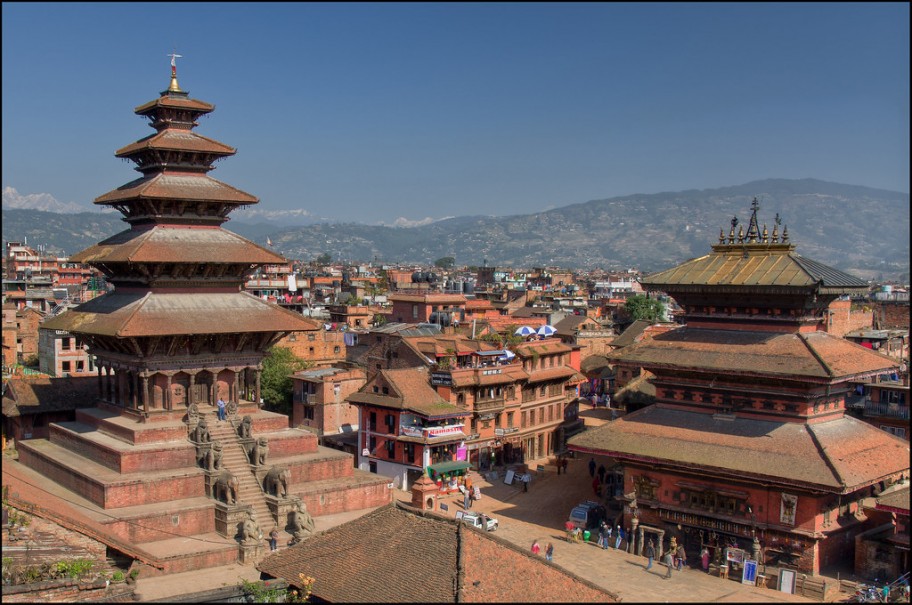
    Its principal monuments include Nyatapola Temple, Bhairavnath Temple and Til Madhav Narayan Temple. The square is also closely connected with Bhaktapur’s major chariot festivals.

    Nyatapola Temple

    The five-tiered Nyatapola Temple dominates the square and the surrounding cityscape. The name Nyatapola refers to its five-storey or five-roof form.

    The temple is dedicated to a powerful tantric goddess, commonly identified with Siddhi Lakshmi. A long stairway rises through five levels of guardian figures, including wrestlers, elephants, lions, griffin-like creatures and goddesses. The symbolic strength of each pair is traditionally understood to be greater than the pair below it.

    Nyatapola rises approximately 33 metres and is regarded as Nepal’s tallest pagoda-style temple. It was commissioned during the reign of King Bhupatindra Malla in the early 18th century.

    Visitors can normally climb the exterior platform for views of Taumadhi Square, but the inner sanctuary is not generally open to the public.

    Bhairavnath Temple

    The multi-roofed Bhairavnath Temple stands near Nyatapola and is dedicated to Bhairava, a fierce manifestation of Shiva.

    The contrast between the towering vertical form of Nyatapola and the broad rectangular form of Bhairavnath creates one of Bhaktapur’s most distinctive architectural scenes. Bhairavnath is also closely associated with the chariot ceremonies of Biska Jatra.

    Til Madhav Narayan Temple

    The less conspicuous Til Madhav Narayan Temple is situated within a courtyard near Taumadhi Square.

    Dedicated to Vishnu in the form of Narayan, it demonstrates how many of Bhaktapur’s important shrines are integrated into residential courtyards rather than standing prominently in open squares.

    Access can depend on religious activities, local ceremonies and courtyard opening conditions.

  • 12:30 PM to 1:15 PM
    Pottery Square

    Continue through narrow streets to Pottery Square, traditionally known as Kumha Tole.

    The square remains associated with families who produce earthenware using inherited pottery techniques. Depending on the weather and production schedule, visitors may see clay being prepared, vessels being shaped on wheels, pots drying in the sun, or finished products being fired and displayed.

    Pottery Square is located within a short walk of Durbar Square and remains a centre for pottery and handicraft shopping.

    A short pottery-making demonstration can be arranged. Guests may also try shaping a small clay object under the supervision of a local potter. This activity may require an additional payment directly to the artisan.

  • 1:15 PM to 2:15 PM
    Traditional Newari Lunch

    Enjoy lunch at a local restaurant or heritage-style courtyard restaurant.

    A typical menu may include:

    • Bara, a savoury lentil pancake
    • Chatamari, a rice-flour dish sometimes described as Newari-style pizza
    • Choila, spiced roasted or grilled meat
    • Aloo tama or seasonal vegetable curry
    • Beaten rice
    • Black soybean or lentil dishes
    • Pickles
    • Juju Dhau
    • Tea or bottled water
    • Vegetarian, vegan, halal-friendly and mild-spice meals can be arranged with advance notice.
  • 2:15 PM to 3:00 PM
    Heritage Lanes and Traditional Neighbourhoods

    After lunch, walk through the old residential quarters connecting Pottery Square with Dattatreya Square.

    This section of the tour provides a closer look at:

    • Traditional Newari brick houses
    • Carved wooden windows and doors
    • Bahal and bahi courtyards
    • Stone water spouts
    • Roadside shrines
    • Community rest houses
    • Grain-drying courtyards
    • Mask, painting and woodcarving workshops
    • Local markets and family-run shops

    These neighbourhoods demonstrate that Bhaktapur is not simply an archaeological site. It is a living city where homes, shrines, workshops, festivals, markets and public spaces remain interconnected.

  • 3:00 PM to 4:15 PM
    Dattatreya Square

    Dattatreya Square, locally associated with Tachapal Tole, is quieter than Durbar Square and Taumadhi Square. It is known for its temple, priestly houses, museums, carved windows and traditional residential architecture.

    Dattatreya Temple

    The three-tiered Dattatreya Temple is dedicated to Dattatreya, a deity representing the combined qualities of Brahma, Vishnu and Shiva.

    The temple is one of Bhaktapur’s oldest and most important religious buildings. It is traditionally associated with the reign of King Yaksha Malla and later renovations by subsequent rulers. The entrance is guarded by figures of legendary wrestlers, while carved wooden elements illustrate the high level of Malla-period craftsmanship.

    Local tradition holds that the temple was constructed from the timber of a single tree, although this is generally presented as a cultural legend rather than a verified construction record.

    Bhimsen Temple

    The nearby Bhimsen Temple is associated with Bhimsen, who is especially revered by traders and merchants in Newar communities.

    Its location reflects the historical importance of trade and commercial guilds in this part of Bhaktapur.

    Pujari Math

    The Pujari Math was traditionally connected with priests serving the Dattatreya Temple.

    The building is one of Bhaktapur’s finest examples of carved timber architecture. Today, parts of the complex are associated with the Woodcarving Museum.

    Peacock Window

    The Peacock Window, locally known as Mhaykhā Jhyā, is set into the façade of the Pujari Math.

    Its radiating carved pattern resembles the tail feathers of a peacock and is frequently regarded as one of Nepal’s most celebrated examples of traditional woodcarving. The window forms part of the Woodcarving Museum building.

    Woodcarving Museum

    The museum contains wooden religious figures, architectural components, windows, decorative panels and examples of historic Newar craftsmanship.

    The same museum ticket can normally be used for the National Art Museum and the Brass and Bronze Museum. Nepal Tourism Board currently lists the foreign visitor fee as NPR 150 and notes that the museum is closed on Tuesdays. Camera and video fees may be charged separately.

    Brass and Bronze Museum

    Located near the Woodcarving Museum, this collection includes ritual vessels, household utensils, religious objects and traditional metalwork.

    The museum provides useful context for understanding how bronze and brass objects were used in temples, homes, festivals and ceremonial life.

  • 4:15 PM
    Free Time for Shopping and Photography

    Spend approximately 30 minutes exploring local shops and cafés.

    Popular products include:

    • Handmade pottery
    • Peacock-window replicas
    • Traditional masks
    • Thanka and paubha paintings
    • Wooden statues
    • Metal religious objects
    • Handmade paper products
    • Local textiles
    • Spices and tea
    • Juju Dhau in traditional clay containers

    The guide can help identify genuine handmade items and explain appropriate bargaining practices.

  • 4:45 PM
    Return Drive

    Meet the driver and begin the journey back to Kathmandu or the agreed drop-off point.

  • 5:30 PM to 6:00 PM
    Hotel Drop-Off

    Arrive at your hotel, depending on traffic and the final drop-off location.

Cost Includes

  • Transportation by private car
  • English speaking guide
  • All entrance fees

 info@makalu-adventure.com
 makaluadventures@gmail.com
 +977-9851037083

ALTITUDE ACCLIMATIZATION

To get the most from your trek, and to stay safe, it is important to follow acclimatization guidelines. At Makalu Adventure, whenever possible, we follow the acclimatization formula set out by Drs Jim Duff and Peter Gormly; experts in Wilderness Medicine. "Above 2000m, altitude illness is a possibility and above 2500m it becomes common".

"As a rough guide, above 2500m the maximum daily height gain between sleeping altitudes should not exceed 400m, with a rest day every third day or after every 1000m of sleeping ascent".

"Avoid overexertion and breathlessness while acclimatizing, stay well hydrated, avoid alcohol, excess caffeine, salt and protein, your diet should be 70% carbohydrate above 3500m".

Why Choose Makalu Adventure

Makalu Adventure has been trading for over 28 years; is one of the leading trek and expedition agents in Nepal and is used as in-country agent by several international adventure companies. At the helm is Mohan Lamsal (MD) assisted by head trekking guide Tenging Sherpa and head climbing guide Sanu Sherpa. Teni started trekking as a porter aged 14 and has hiked every trail in Nepal, many times! Sanu Sherpa has the distinction of having climbed all 14, 8,000m peaks, twice! Mohan Lamsal is not only MD of Makalu Adventure, he is also the General Secretary of the Nepal Mountaineering Association. You are in safe hands with Makalau Adventure.

Client Reviews

EXCELLENT : (5 / 5.0 ) 94

100% recommend this Package.
Score Breakdown
  • Michal Wensierski
    Poland/England

    Excellent service and a welcome by Makalu Adventure

    My name is Michal from Poland/England. I summitted Everest on 15th May 2025, 07:55 AM despite of heavy winds. Me and my Sherpa Phurba were only two people to summit on that day. I summitted with Makalu Adventure which is a great company, with great people and amazing supplies. Everything you need, from base camp to....
    Read More: Alumnus Michal achieves childhood dream as he summits Mount Everest
  • Rhisael Rabe
    Philipines

    Great Service! Very good company Makalu Adventure for Expedition

    I successfully climbed Mt Everest (8848.86 m). The climbing was much adventurous and challenging than other peaks I submitted before. Well it was definitely dangerous and thrilling but what made it easier and worth it was Makalu Adventures. I'm so glad my friend recommended me Makalu Adventure. The whole trip was so well organized, the sherpas (Phurba Onggel Sherpa and Dasange Sherpa) guided us all the way to the summit making the journey smooth. I had a lot of fun and the accommodation along with the food was great even in the higher altitude which I did not foresee. It was an experience to remember for a lifetime. Thank you Makalu Adventures for a great adventure. Great services
  • Babar Ali
    Bangladesh

    Historic moment unfolded in the world of mountaineering


    See more pictures on Instagram

  • Georges Abou Rjeili
    Canada

    Thank you Makalu Adventure team for organizing Everest Expedition Journey

    Hello my name is Georges Abou Rjeili from Canada and I just completed summitting Everest with Makalu Adventure. Overall it's a great company and I would recommend it for everyone. Thank you


  • Gabriella Nicola Nel
    South Africa

    Wonderful experience of World's Highest Mountain Mt. Everest (8848.86 m) climbing

    My name is Gabriella Nicola Nel, I just submitted Mount Everest with Makalu Adventure. It was an incredible experience; we did have some hiccups in terms of getting frostbite on the way down from the summit and I'd just like to thank Mohan and the Makalu Adventure team for organizing a long long rescue from Camp 3 which is extremely difficult and I believe that the company saved my life with a successful Summit. As well for the season which was a very dangerous season I'd just like to thank everyone from Makalu Adventure.


  • Thomas G Masterson
    Canada

    Thanks Makalu Adventure team for organizing trip to Top of the World

    I climbed of Mount Everest with Makalu Adventure. We got to Camp three on Everest and the quality of the Sherpas in helping was excellent and the quality of the food in both base and advanced base camp was very good.


  • Michael
    -

    Wonderful Experience and thanks to Makalu Adventure for organizing trip

  • Saman Tahmooresi
    Iran

    Many thanks to Makalu Adventure

    Saman Tahmooresi has successfully climbed World's highest Mountain Mt. Everest (8848.86 m) on 13th May 2022


  • Arthur George Prestidge
    -

    Wonderful adventure Experience of Himalayas and Climbing

    Arthur George Prestidge has successfully climbed World's highest Mountain Mt. Everest (8848.86 m)


  • Akke Rahman
    Bangladesh

    Thanks to Mohan Lamsal and Makalu Adventure team for organizing trip to Top of the World

    Thanks to Mohan Lamsal and Makalu Adventure team for organizing trip to Top of the World, Mt. Everest. Yahoo, I successfully climbed the Top of the World : Mount Everest 8848M on Friday 13th May 2020 07:30 AM


Ask an Expert - Makalu Adventure
Similar trips
Get Social

Get Connected

Stay Updated

Subscribe to our Newsletter