The Green Boots on Mount Everest: The Tragic ...
22 August, 2026
Read More
Mount Manaslu is often described as the perfect first 8000-meter peak, yet it is far from easy. Rising to 8,163 meters, it is the eighth highest mountain in the world and offers a true Himalayan expedition experience with fewer crowds than Everest.
For climbers, it is a gateway to high-altitude mountaineering. For customers and adventure seekers, it is a serious investment in time, money, and preparation.
This guide simplifies everything you need to know, from cost and route to difficulty and preparation.
The formidable Mount Manaslu rises to 8,163 meters, making it the eighth highest mountain on Earth and one of the most compelling choices for climbers seeking a true Himalayan expedition. Unlike its more crowded counterparts, Manaslu offers a quieter, more immersive experience—one that feels closer to the golden age of exploration, when mountains were approached with reverence and uncertainty.
In 2026, interest in Manaslu continues to grow, particularly among climbers looking for a serious 8000-meter challenge without the overwhelming traffic of Everest. Yet before any dream takes shape, one question consistently arises: how much does it cost to climb Manaslu? This guide answers that question in detail while also exploring routes, difficulty, and essential planning insights.
The cost of a Manaslu expedition in 2026 typically ranges between $12,000 and $18,000 USD, depending on the level of service, logistics, and support provided. For many climbers, the largest portion of this expense comes from a full board expedition package, which includes permits, base camp services, meals, and logistical coordination throughout the climb.
Permit fees issued by the Nepal government cost around $1,800, while experienced Sherpa support—essential for safety and success—can range from $2,000 to $4,000. Oxygen systems, often used above 7,000 meters, add another $1,500 to $3,000 depending on usage. Additional costs such as gear, insurance, and travel can easily exceed $1,000.
Most climbers opt for a full board package, which simplifies the expedition by bundling accommodation, meals, route fixing, and support staff into one cohesive service. This not only enhances safety but also allows climbers to focus entirely on the ascent rather than logistics.
The standard route on Mount Manaslu follows the northeast face, a path that balances accessibility with high-altitude challenge. Climbers begin at base camp around 4,800 meters and gradually ascend through a series of camps positioned to aid acclimatization.
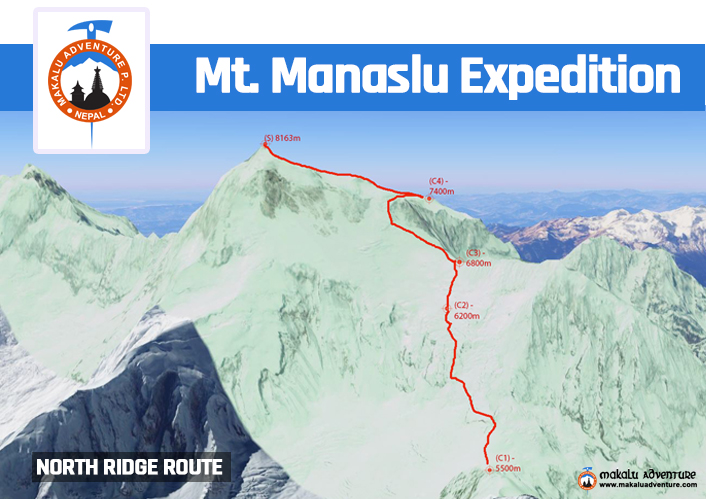
Camp I sits at approximately 5,700 meters, followed by Camp II at 6,400 meters and Camp III at 6,800 meters. Camp IV, located at 7,400 meters, serves as the final staging point before the summit push. From here, climbers attempt the 8,163-meter summit, navigating steep snow slopes and an exposed ridge that demands both focus and endurance.
Though less congested than Mount Everest, the route presents real dangers, including avalanches, crevasses, and rapidly changing weather conditions. It is a climb that rewards patience and punishes haste.
Manaslu is often described as one of the more approachable 8000-meter peaks, yet such descriptions can be misleading. The mountain demands a high level of physical fitness, mental resilience, and prior experience at altitude. Climbers are expected to be comfortable using fixed ropes, navigating icy terrain, and enduring prolonged exposure to extreme conditions.
The true challenge lies not in technical climbing alone, but in the effects of altitude. Above 7,000 meters, the human body begins to deteriorate, and even simple movements require immense effort. In this sense, Manaslu is not merely a climb—it is a test of endurance against nature itself.
The best time to climb Manaslu is during the autumn season, from September to November, when weather conditions are most stable and summit windows are more predictable. During this period, climbers benefit from clearer skies, reduced risk of avalanches, and higher success rates.
Spring, from March to May, offers an alternative season with slightly warmer temperatures but less consistent conditions. While still viable, it is generally considered secondary to the autumn season for summit attempts.
Mount Manaslu is located in the Gorkha District of Nepal, within the Manaslu Conservation Area. This remote region is known for its dramatic landscapes, deep valleys, and culturally rich villages influenced by Tibetan traditions.
The journey to base camp often includes trekking through the Budi Gandaki valley, crossing suspension bridges, and passing through ancient settlements that offer a glimpse into life in the high Himalaya. It is as much a cultural journey as it is a physical one.
In the grand narrative of mountaineering, Mount Manaslu occupies a special place—one that bridges the gap between adventure and accessibility. It offers a genuine expedition experience without the overwhelming commercialization found on more famous peaks.
For those willing to invest the time, resources, and preparation, Manaslu in 2026 presents an extraordinary opportunity. It is a mountain that demands respect, rewards persistence, and leaves those who summit forever changed.
And so, dear reader, whether you approach it with the spirit of a 19th-century explorer or the precision of a modern planner, Manaslu awaits—silent, formidable, and utterly magnificent.
![Complete Guide to Mera Peak Climbing 2026 [Updated]](https://makaluadventure.com/public/uploads/frontend/thumb/mera_peak_climbing_168883208074961.jpg)